
Date Converter
Use the converter to transform any Gregorian date into the corresponding French Revolutionary calendar date, and vice versa. The algorithm uses historically verified equinox dates for years I-XIV (1792-1805) and the Romme method for later dates.
History of the Revolutionary Calendar
The French Revolutionary calendar, also known as the Republican calendar, was one of the most ambitious projects of the French Revolution: redesigning time itself. It was not a simple renaming exercise, but a radical restructuring of how the French measured days, weeks, and years.
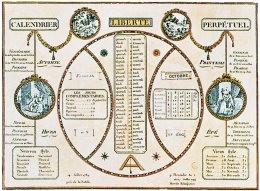
Why a New Calendar?
The revolutionaries saw the Gregorian calendar as a symbol of the Ancien Regime and the power of the Catholic Church. Every day was dedicated to a saint, holidays marked the liturgical year, and the seven-day week had biblical origins. To build a society based on reason and nature, a new calendar was needed.
The idea was part of a broader decimalization project that included the metric system (still in use) and decimal time (abandoned). The calendar was meant to reflect nature, seasons, and agricultural work instead of saints and religious holidays.
Who Created It
The calendar was the result of the work of two key figures:
- Gilbert Romme (1750-1795), mathematician and deputy, designed the mathematical structure: 12 months of 30 days, decades of 10 days, complementary days.
- Fabre d’Eglantine (1750-1794), poet and playwright, devised the evocative month names and created the rural calendar, assigning each day a name connected to nature.
The decree was approved on 24 October 1793 (3 Brumaire An II) by the National Convention.
Period of Use
The calendar was in effect from 22 September 1792 to 1 January 1806, when Napoleon abolished it. It was briefly revived during the Paris Commune in 1871, for just 18 days.
How the Revolutionary Calendar Works
The 12 Months and Their Meaning
Fabre d’Eglantine chose names that evoked the weather and agricultural conditions of each period. The months are grouped into four seasons, recognizable by their suffix:
| Season | Month | Meaning | Approx. Gregorian Period |
|---|---|---|---|
| Autumn (-aire) | Vendemiaire | Grape harvest | 22 Sep – 21 Oct |
| Brumaire | Fog, mist | 22 Oct – 20 Nov | |
| Frimaire | Frost | 21 Nov – 20 Dec | |
| Winter (-ose) | Nivose | Snow | 21 Dec – 19 Jan |
| Pluviose | Rain | 20 Jan – 18 Feb | |
| Ventose | Wind | 19 Feb – 20 Mar | |
| Spring (-al) | Germinal | Germination | 21 Mar – 19 Apr |
| Floreal | Flower | 20 Apr – 19 May | |
| Prairial | Meadow | 20 May – 18 Jun | |
| Summer (-idor) | Messidor | Harvest | 19 Jun – 18 Jul |
| Thermidor | Heat | 19 Jul – 17 Aug | |
| Fructidor | Fruit | 18 Aug – 16 Sep |
The suffixes make it easy to identify the season: -aire for autumn, -ose for winter, -al for spring, -idor for summer.
The Decade: 10-Day Weeks
The week was replaced by the decade, a 10-day period. The days were called: Primidi, Duodi, Tridi, Quartidi, Quintidi, Sextidi, Septidi, Octidi, Nonidi, Decadi (rest day).
The decade was one of the most unpopular aspects of the calendar: workers went from one rest day every 7 to one every 10.
The Sansculottides: Complementary Days
With 12 months of 30 days we reach 360, leaving 5 days short (6 in leap years). These days, called Sansculottides, fell at the end of the year and were dedicated to republican values: Virtue, Genius, Labour, Opinion, Rewards, and Revolution (leap years only).
Leap Years and the Autumnal Equinox
The republican year began on the day of the autumnal equinox. During the historical period (years I-XIV), leap years were III, VII, and XI. For later dates, the Romme method is used: divisible by 4, not by 100, unless by 400.
Famous Dates in the Revolutionary Calendar
| Republican Date | Gregorian Date | Event |
|---|---|---|
| 1 Vendemiaire An I | 22 September 1792 | Proclamation of the Republic |
| 2 Pluviose An I | 21 January 1793 | Execution of Louis XVI |
| 12 Germinal An II | 1 April 1794 | Abolition of slavery in French colonies |
| 9 Thermidor An II | 27 July 1794 | Fall of Robespierre, end of the Terror |
| 13 Vendemiaire An IV | 5 October 1795 | Napoleon suppresses the royalist uprising |
| 18 Fructidor An V | 4 September 1797 | Directory coup against monarchists |
| 18 Brumaire An VIII | 9 November 1799 | Napoleon’s coup d’etat |
| 11 Frimaire An XIII | 2 December 1804 | Napoleon’s coronation as Emperor |
| 10 Nivose An XIV | 31 December 1805 | Last day of the calendar |
The expressions “9 Thermidor” and “18 Brumaire” have become universal synonyms for “counter-revolutionary reaction” and “military coup d’etat” respectively. Karl Marx wrote in The Eighteenth Brumaire of Louis Bonaparte (1852) the famous phrase: “history repeats itself, first as tragedy, then as farce.”
The Rural Calendar: A Name for Every Day
Every day of the year bore the name of a natural element: Quintidi days were named after an animal, Decadi days after an agricultural tool, and all other days after plants, flowers, or minerals. Examples: 1 Vendemiaire = Grape, 5 Floreal = Nightingale, 27 Messidor = Strawberry.
Trivia and Pop Culture
- Lobster Thermidor: the famous dish is named after the summer month
- Germinal by Zola: the 1885 novel takes its title from the spring month
- The Paris Commune (1871) briefly restored the calendar
- The metric system is the only decimal reform of the Revolution that survived
Frequently Asked Questions
When does the year begin in the Revolutionary calendar?
The republican year begins on the day of the autumnal equinox, usually 22 or 23 September. Year I began on 22 September 1792.
What is 18 Brumaire?
18 Brumaire An VIII (9 November 1799) is the date of Napoleon’s coup d’etat. The expression has become synonymous with military coup.
How long was the Revolutionary calendar in use?
It was in effect for about 13 years, from 22 September 1792 to 1 January 1806. It was briefly revived during the Paris Commune in 1871.
What are the Sansculottides?
They are the 5 or 6 complementary days at the end of the year, dedicated to republican values: Virtue, Genius, Labour, Opinion, Rewards, and Revolution (leap years only).